
Please Choose Your Language
close
Choose Your Site
Global
Social Media
Views: 0 Author: Site Editor Publish Time: 2026-09-01 Origin: Site


Transitioning from traditional whole bean or ground coffee sales to single-serve K-Cup production represents a high-margin revenue stream. It introduces strict mechanical tolerances and quality control demands. For many specialty roasters, K-Cups begin as an ancillary offering. Scaling this production without dedicated, reliable equipment quickly disrupts core whole-bean operations and strains facility resources. Relying on inadequate machinery leads to inconsistent extraction due to dosing variances, rapid staling from poor seals or inadequate nitrogen flushing, and significant material waste from high scrap rates and mechanical downtime. To protect brand reputation and maintain operational efficiency, roasters and co-packers must evaluate equipment based on verifiable throughput, dosing precision, and seal integrity. Selecting the right coffee capsule filling machine requires looking beyond baseline specifications to understand how mechanical design impacts daily production. The ideal system ensures consistent cup quality while integrating seamlessly into existing facility workflows.
Configuration Dictates Scalability: The choice between linear and rotary machine architectures fundamentally impacts facility footprint, throughput (Cups Per Hour), and maintenance accessibility.
Precision and Preservation are Non-Negotiable: Servo-driven auger dosing (maintaining 5-15g tolerances) and integrated nitrogen flushing (targeting<1% residual oxygen) are critical for product consistency and shelf life.
Sealing Technology Drives Yield: A reliable coffee capsule sealing machine component must offer adjustable heat and pressure settings via the HMI to accommodate evolving pod materials, including compostables.
Evaluating machine speed requires distinguishing between theoretical maximum output and actual operational yield. A machine rated for 12,000 cups per hour operates at that speed only under perfect conditions. Actual yield accounts for micro-stoppages, film roll splices, bulk coffee replenishment, and daily sanitation cycles. When calculating required throughput, analyze current demand and add a 36-month growth projection to avoid outgrowing the equipment prematurely. Relying on a K Cup filling machine that barely meets current quotas guarantees production bottlenecks during peak seasons.
Scaling output efficiently often depends on multi-lane configurations and cavity counts. Upgrading from a 2-cavity to a 4-cavity system doubles the output per machine cycle without doubling the mechanical speed. Running a machine at lower cyclic speeds with more cavities reduces wear on moving parts, decreases vibration, and improves dosing accuracy compared to running a single-lane machine at its absolute maximum mechanical limit. Understanding Overall Equipment Effectiveness (OEE) provides a realistic picture of daily production capabilities.
| Production Configuration | Theoretical Output (Cups/Min) | Actual Operational Yield (85% OEE) | Ideal Application |
|---|---|---|---|
| 2-Lane System | 120 | 102 | Micro-roasters and pilot programs |
| 4-Lane System | 240 | 204 | Mid-sized commercial co-packers |
| 6-Lane System | 360 | 306 | High-volume industrial facilities |
Physical footprint dictates machine selection, especially for small to medium enterprises with limited floor space. Operators need sufficient clearance around the machine for loading raw materials, clearing jams, and performing routine maintenance. A machine placed too close to a wall restricts access to rear panels, turning a five-minute sensor adjustment into a prolonged shutdown. You must also account for the vertical clearance required by bulk coffee feeders and overhead hoppers.
Commercial pod production demands specific industrial utilities. Standard facility power is rarely sufficient. Implement these utility upgrades before installation:
Verify three-phase power drops are available to drive heavy-duty servo motors and maintain stable heating elements without voltage drops.
Install a dedicated rotary screw air compressor with an integrated air dryer. Pneumatic cylinders require clean, dry compressed air. Moisture in the air lines will foul pneumatic valves and contaminate the coffee.
Plumb rigid nitrogen lines from a bulk liquid nitrogen tank or an on-site nitrogen generator. Relying on standard high-pressure cylinders results in constant changeovers and inconsistent gas flow.
Map out operator walking paths to ensure raw materials can be staged near the machine without blocking forklift traffic.
Linear machines utilize an in-line walking-beam mechanism to advance cups through various stations. This architecture excels in multi-lane scalability. Manufacturers can easily expand linear frames to accommodate four, six, or eight lanes, achieving massive throughput. Maintenance teams generally prefer linear designs because all stations—cup denesting, filling, tamping, sealing, and ejection—are laid out in a straight line, offering unobstructed access to components. The primary trade-off is the significant floor space required.
Rotary machines operate on a carousel-style indexing dial plate. Stations are positioned in a circle around the central hub. This design is highly compact, making it suitable for facilities with tight spatial constraints. A single operator can easily monitor all stations from one position. However, maintaining rotary systems requires navigating a denser cluster of internal components. Accessing the central manifold or replacing a cam underneath the dial plate demands more technical effort than servicing a linear track.
| Feature | Linear Configuration | Rotary Configuration |
|---|---|---|
| Footprint | Long and narrow, requires significant floor space | Compact and square, fits in tight facility layouts |
| Scalability | High (easily add more lanes to the frame) | Low (fixed dial plate size limits expansion) |
| Maintenance Access | Excellent (open sides allow easy component reach) | Challenging (dense internal hub restricts access) |
Semi-automatic models serve as entry-level tools for recipe testing or micro-roasters exploring the single-serve market. These units require operators to manually load empty cups into the holding plates and sometimes manually initiate the fill or seal cycles. While useful for low-volume testing, they introduce high labor dependency and increase the risk of human error in quality control, leading to inconsistent seals and variable fill weights. You cannot build a scalable production schedule around manual cup loading.
Commercial viability requires a fully automatic capsule filling machine. These systems handle the entire process without manual intervention. Automated denesters strip cups from stacks and drop them into the transport plates using vacuum suction. Sensors verify cup presence before the servo-driven auger dispenses the coffee. Automated pick-and-place arms position the lids, and pneumatic sealing heads secure the closure. This automation ensures strict adherence to quality parameters, drastically reduces material waste, and allows operators to focus on staging materials rather than micromanaging the machine cycle.
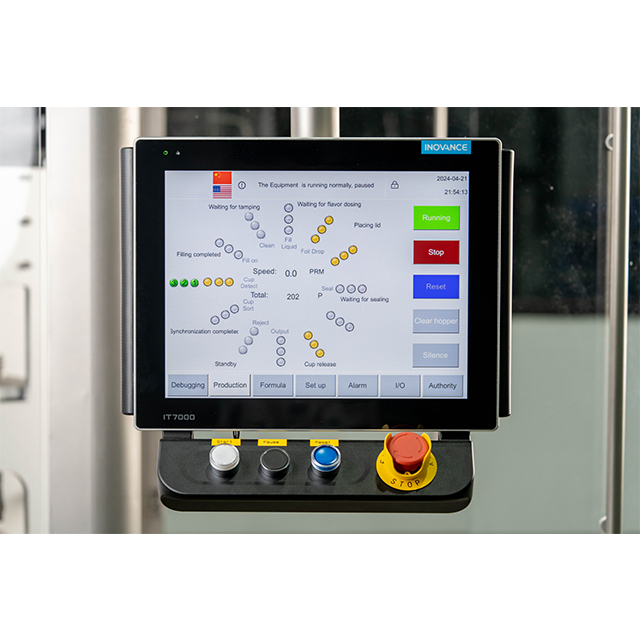
Coffee density fluctuates based on origin, roast profile, and ambient humidity. Dark roasts are less dense and occupy more volume than light roasts of the same weight. Servo-driven auger fillers handle these variations by providing exact control over the auger screw's rotation. Operators can adjust the filling volume down to fractions of a gram via the Human-Machine Interface (HMI). Maintaining a strict 5-15g tolerance is critical. Overfilling prevents proper sealing because grounds contaminate the cup rim. Underfilling results in weak, under-extracted coffee that damages your brand reputation.
Advanced systems incorporate automated feedback loops using in-line checkweighers. The machine weighs a sample of filled cups and automatically adjusts the servo auger if weights begin trending out of tolerance. This closed-loop system prevents continuous production of rejected pods. Beyond standard grounds, high-quality machines offer the versatility to handle soluble teas, hot chocolate powders, and flavored coffees. This requires specialized auger tooling, such as different flight pitches, to prevent fine powders from bridging in the hopper or free-flowing uncontrollably through the nozzle.
Freshly roasted coffee releases volatile aromatic compounds that degrade rapidly upon exposure to oxygen. Nitrogen flushing displaces ambient oxygen inside the capsule, halting lipid oxidation and extending shelf life from weeks to months. The industry standard requires achieving less than 1% residual oxygen inside the sealed pod. Achieving this metric consistently separates professional equipment from entry-level alternatives.
Effective nitrogen flushing relies on the design of the flushing tunnel. The machine must maintain a controlled, enclosed environment from the filling station through to the sealing station. Simply blowing gas at the cup creates turbulent flow, which mixes oxygen back into the pod. A properly designed system uses laminar flow to blanket the open cups in heavy nitrogen gas. The efficiency of this tunnel directly impacts gas consumption. Poorly sealed tunnels require massive volumes of nitrogen to achieve target oxygen levels, straining facility utility capacities and causing unnecessary operational headaches.
The integrity of the pod relies entirely on the sealing mechanism. A reliable coffee capsule sealing machine component operates on the triad of time, temperature, and pressure. Heat sealing requires precise, independent temperature controls for each sealing head. If a multi-lane machine uses a single heating block, temperature variations across the lanes will cause some pods to scorch while others fail to bond. PID (Proportional-Integral-Derivative) controllers are mandatory for maintaining exact temperatures across all sealing stations.
Pressure application must be consistent to prevent micro-leaks. Pneumatic cylinders drive the sealing heads down onto the cup rims. Operators must be able to adjust this pressure easily via the HMI to accommodate different lid materials. The system must also support different lid formats. Pre-cut foil lids require precise vacuum pick-and-place mechanisms to ensure they drop perfectly centered on the cup. Roll-stock film requires accurate tension control and die-cutting blades to ensure clean edges without plastic stringers hanging off the finished pod.
The single-serve market is shifting away from standard polystyrene (PS) and polypropylene (PP) cups toward more sustainable options. Equipment must adapt to aluminum capsules and emerging compostable or biodegradable materials. Standard plastic cups offer a wide sealing window, meaning they bond well across a broad range of temperatures. Alternative materials behave differently under heat and pressure, requiring highly adaptable sealing technology.
Compostable materials, such as PLA (Polylactic Acid), present significant packaging challenges. They possess a very narrow sealing temperature tolerance. If the sealing head is too hot, the compostable rim melts, deforms, and sticks to the tooling. If it is too cold, the lid fails to adhere, resulting in blowouts during brewing. The filling machine must feature highly responsive temperature controllers and specialized non-stick coatings on the sealing heads to process these sustainable materials efficiently without causing massive jam-ups.
Facilities producing multiple pod formats need modular equipment. The ability to switch between K-Cup, Nespresso, and Dolce Gusto formats on a single machine increases operational flexibility. Evaluate the technical expertise required for these changeovers. Swapping transport plates, dosing nozzles, and sealing heads should utilize quick-release mechanisms rather than requiring complex recalibration by a senior technician. Acceptable changeover times range from 30 to 60 minutes. Anything longer severely impacts daily uptime and disrupts production schedules.
Sanitation protocols are equally critical, particularly when switching between traditional roasts and flavored coffees. Flavor ghosting occurs when residual oils from a hazelnut or vanilla roast contaminate a subsequent batch of single-origin coffee. Toolless disassembly of the dosing hopper and auger is mandatory. Sanitary design features, such as steeply angled conical hoppers and polished stainless-steel contact parts, eliminate blind spots where powder accumulates. This ensures thorough cleaning during washdowns and protects the flavor integrity of your coffee.
Material waste directly impacts facility efficiency. A machine operating with a 5% scrap rate destroys margins over a year of continuous production. High scrap rates usually stem from poor sensor integration or inconsistent mechanical indexing. You need equipment designed to identify and isolate errors before they compound into massive material losses.
Look for machines equipped with "no cup, no fill" and "no lid, no seal" sensor logic. If the denester fails to drop a cup into a specific cavity, the optical sensor detects the empty slot and signals the PLC to skip the filling and sealing steps for that specific lane. This prevents coffee from dumping directly into the machine chassis, which would require an immediate shutdown for cleaning. Similarly, if a lid fails to drop, the sealing head will not engage, preventing melted plastic from adhering to the bare heating element.
The origin of internal components dictates how quickly you can recover from a mechanical failure. Machines built with proprietary PLCs, custom pneumatic manifolds, or obscure servo motors force you to rely entirely on the manufacturer for replacement parts. If a proprietary sensor fails, you might wait weeks for an overseas shipment, leaving your production line completely paralyzed.
Prioritize machines built with off-the-shelf, globally recognized components. Systems utilizing Allen-Bradley, Siemens, or Omron PLCs, alongside Festo or SMC pneumatics, allow your maintenance team to source replacement parts from local industrial supply houses. This standardized approach to machine building drastically reduces downtime and simplifies troubleshooting for your in-house technicians.
Purchasing complex machinery without adequate localized support introduces severe operational risk. Highly sophisticated equipment requires operators who understand how to navigate the HMI, interpret fault codes, and perform routine preventative maintenance. Relying solely on a manual is insufficient for industrial packaging lines. Operators must know how to dial in the machine for different roast profiles and troubleshoot minor pneumatic faults.
Prioritize Original Equipment Manufacturers (OEMs) that provide comprehensive on-site training during commissioning. The HMI must be available in the operators' native language, with clear, intuitive diagnostic screens. Remote diagnostic capabilities allow OEM technicians to log into the machine's PLC via a secure internet connection to troubleshoot software issues. This bypasses the need for immediate on-site visits and drastically reduces downtime during the critical first months of operation.
A high-speed filling machine creates a bottleneck if the end-of-line packaging process relies on manual labor. Producing 200 cups per minute is useless if operators can only pack 50 cups per minute into retail cartons. True end-to-end efficiency requires seamless integration with downstream equipment to maintain continuous flow.
Evaluate how the coffee pod packaging machine communicates with automated cartoning machines, case packers, and palletizers. The filling line should feature accumulation tables or buffer zones to hold sealed pods temporarily if the cartoner experiences a minor jam. Integration via standardized communication protocols ensures that if the downstream equipment stops, the filling machine automatically pauses. This prevents a massive overflow of loose pods on the factory floor and allows operators to clear the jam safely.
Schedule a Factory Acceptance Test (FAT) using your specific roast profiles, flavored powders, and cup materials before authorizing machine shipment.
Audit your facility's compressed air and nitrogen generation capacity to ensure they meet the continuous CFM requirements of the new equipment.
Standardize your lid and cup material suppliers to prevent unexpected sealing failures caused by varying plastic compositions.
Establish a preventative maintenance schedule focusing on pneumatic cylinder lubrication, sensor cleaning, and sealing head calibration.
A: Production speeds vary heavily based on machine architecture. Entry-level automated models typically output 1,500 to 3,000 cups per hour. Mid-range linear systems handle 4,000 to 8,000 cups per hour. Industrial multi-lane, 4-cavity systems can exceed 12,000 cups per hour. Actual operational yield depends on material quality, operator efficiency, and the frequency of bulk coffee replenishment.
A: Nitrogen flushing involves flooding the dosing and sealing chambers with heavy nitrogen gas. This process displaces ambient oxygen inside the capsule before the lid is applied. By removing oxygen, the machine halts lipid oxidation, preventing the coffee from turning stale and significantly extending the product's shelf life.
A: While some machines offer interchangeable tooling for different formats, the changeover process requires swapping transport plates, dosing nozzles, and sealing heads. This can be labor-intensive and requires recalibration. High-volume production facilities typically dedicate specific machines to a single format to maximize daily uptime.
A: Yes, high-quality machines can handle various soluble powders and teas. This requires adjustable servo-driven auger settings to accommodate different bulk densities and flow characteristics. Easy-clean hoppers and toolless disassembly are mandatory to prevent cross-contamination and flavor ghosting between different product runs.
A: Poor seals are primarily caused by inconsistent heat distribution across the sealing heads, incorrect pneumatic pressure, or incompatible lid and cup materials. Additionally, static electricity can cause coffee grounds to jump onto the cup rim during filling, preventing the foil lid from bonding cleanly to the plastic.
A: Commercial standards require strict dosing tolerances, typically ranging from ±0.15g to ±0.2g per pod. Maintaining this precision ensures consistent extraction and flavor profiles for the end consumer. Servo-driven augers paired with in-line checkweighers are necessary to achieve and maintain these tight tolerances.
A: Operating a commercial filling line requires three-phase electricity to power servo motors and heating elements steadily. It also requires a robust supply of clean, dry compressed air for pneumatic cylinders, and a bulk nitrogen supply or on-site nitrogen generator for the gas flushing process.


