
Please Choose Your Language
close
Choose Your Site
Global
Social Media
Views: 0 Author: Site Editor Publish Time: 2026-09-07 Origin: Site


The true bottleneck in automated packaging rarely involves the bagging mechanism itself. We consistently see the real issue lies in the synchronization between the bagger and the filler. Plant managers often upgrade their bagging equipment expecting massive throughput gains, only to discover that a fast bagger cannot compensate for a slow or inaccurate filler. The entire line moves only as fast as its weakest link. Mismatched systems create severe operational headaches. Excessive product giveaway destroys material yield. Improper product drops cause seal contamination, leading to rejected bags and messy rework. Overall Equipment Effectiveness (OEE) plummets while operators face frequent downtime for cleaning and clearing jams. You cannot solve these issues by simply turning up the machine speed. You must evaluate the entire system as a single integrated unit. This technical evaluation framework helps plant managers and packaging engineers pair a bagging system with the correct dosing technology based on product physics, throughput requirements, facility constraints, and accuracy tolerances.
Product Physics Dictate the Filler: The physical state of the product (powder, granule, liquid, irregular solid, fragile) is the non-negotiable starting point for selecting an automatic dosing system.
Synchronization is Critical: A high speed packaging machine is only as efficient as the settling time and cycle speed of its paired dosing unit.
Accuracy vs. Giveaway: Investing in high-precision dosing (like a combination scale) reduces product giveaway, directly offsetting higher initial capital expenditures in high-volume operations.
Integration Risks: Independent PLCs between the filler and the bagger can cause timing lags; unified or seamlessly integrated controls are required for optimal OEE.
You must establish strict baseline metrics before evaluating equipment. Bags per minute (BPM) serves as the standard throughput metric, but theoretical BPM often ignores real-world plant conditions. You need to define target OEE percentages. OEE accounts for availability, performance, and quality. Acceptable changeover times also play a massive role in actual daily output. A machine that runs at 150 BPM but takes four hours to clean between product runs will yield lower daily output than a 100 BPM machine that cleans in twenty minutes.
Throughput expectations must account for the entire system cycle time. The mechanical limit of the bagger means nothing if the filler lags behind. You must calculate the true cycle time by adding up every sequential action in the process.
Weighing and dosing duration inside the filler head.
Product transit time falling through the transition chute and forming tube.
Jaw actuation and sealing dwell time required to melt the film layers.
Film pull and discharge clearance to move the finished bag out of the seal zone.
A 120 BPM bagger paired with a 60 BPM filler yields exactly 60 BPM. You must match the cycle speeds perfectly to maximize throughput.
Overfilling bags destroys material yield. You must calculate the volume of this giveaway over a fiscal year. Even a few grams per bag adds up to massive material loss in high-volume facilities. Track the average overfill weight per bag and multiply this by your daily production volume. Strict weight tolerances justify advanced dosing technology. Precision equipment hits the target weight consistently, reducing the standard deviation of your fill weights. You can set your target closer to the label weight, protecting your material inventory.
| Overfill Per Bag (grams) | Line Speed (BPM) | Shifts Per Day (8 hours) | Annual Material Loss (lbs) |
|---|---|---|---|
| 2g | 60 | 1 | 3,960 lbs |
| 2g | 120 | 2 | 15,840 lbs |
| 5g | 60 | 1 | 9,900 lbs |
| 5g | 120 | 2 | 39,600 lbs |
Product trapped in the seal area causes leakers. Leakers ruin product freshness and cause secondary messes in shipping cases. Trailing product remains the primary culprit. If the product drop takes too long, pieces fall through while the jaws close. Improper drop timing guarantees seal contamination. You must define success using specific defect rates, aiming for less than 0.1% seal failure.
Achieving this requires perfect timing between the product drop and jaw actuation. The product must clear the seal zone completely before the jaws meet. Operators verify this using vacuum water bath testing or burst testing on the plant floor. Clean seals ensure product safety and extend shelf life. If you see product caught in the horizontal seal, you immediately know your dosing cycle is out of phase with your film pull.
Multi-head weighers dominate the solid food sector. They handle snacks, frozen foods, hardware, and fresh produce. The mechanics rely on multiple weigh buckets arranged in a circle. Product feeds into the top via a dispersion cone and distributes into these buckets using vibrating radial feeder pans. Each bucket weighs its contents independently using highly sensitive load cells.
The internal algorithm performs rapid calculations. It evaluates the weights in all available buckets and selects the specific combination of buckets that equals the target weight. This process happens in fractions of a second. A combination scale minimizes giveaway while maintaining high speeds. It remains the most accurate solution for irregular solids. For sticky products like gummies or fresh poultry, engineers specify dimpled bucket surfaces to prevent product from clinging to the metal.
Delicate items require gentle handling. Baked goods, brittle snacks, and crackers cannot survive a standard gravity drop. High impact velocity shatters the product, creating unacceptable levels of dust and crumbs inside the bag. Standard multi-head weighers often drop product too far and too fast for these applications. You must modify the dosing process to protect product integrity.
Integration requires specialized components. Angled forming tubes reduce the vertical drop speed by forcing the product to slide rather than free-fall. Staging mechanisms catch and release the product in steps. Specialized linear weighers slide product gently into the vertical packaging machine. Engineers often coat the transition chutes with polyurethane to absorb impact energy. Gentle handling prevents excessive crumbs and broken pieces.
Powders behave differently based on their physical properties. Free-flowing powders like granulated sugar move easily and drop predictably. Non-free-flowing powders like flour, whey protein, or spices tend to clump, bridge, and rat-hole inside the hopper. You must differentiate between these two categories because the physical behavior dictates the specific auger tooling required.
Auger tooling consists of a servo-driven screw and a surrounding funnel. You must customize these components for the specific powder. Free-flowing powders require spinner plates at the bottom of the auger to prevent uncontrolled dripping between cycles. Non-free-flowing powders need independent agitation blades rotating inside the hopper to force the powder down into the auger flights. Proper tooling ensures a consistent, accurate dose every cycle without leaking powder into the seal zone.
Volumetric filling works well for products with consistent bulk density. Rice, beans, and certain pet foods fit this category perfectly. The system measures by volume rather than weight. Rotating telescopic cups fill with product as they pass under the hopper. A stationary brush scrapes the top of the cup level. The cups then rotate over a discharge port and drop the volume into the bagger below.
This method presents a clear mechanical trade-off. Volumetric fillers offer high speed and extreme mechanical simplicity. They lack the complex load cells and algorithms of a scale. However, they provide lower accuracy compared to gravimetric weighing. If your product density fluctuates, the final bag weight will fluctuate. You must ensure your product density remains highly consistent to use volumetric cups effectively.
Packaging liquids requires specialized pumping systems. Sauces, condiments, and chemical liquids demand precise volumetric control. Piston pumps draw a specific volume of liquid into a cylinder on the backstroke. The piston then pushes the liquid down through the forming tube into the bag on the forward stroke. Rotary valves direct the flow of the liquid to ensure it only moves in one direction.
Dripping is the biggest risk in liquid packaging. You must use positive shut-off nozzles at the end of the fill tube. These nozzles seal completely between cycles using pneumatic actuators. They prevent any fluid from dripping into the seal zone. Liquid in the seal zone guarantees a failed seal and a leaking bag. Clean cut-offs are mandatory for liquid applications. For highly viscous products or liquids with particulates like salsa, the hopper requires continuous agitation to keep the solids suspended.
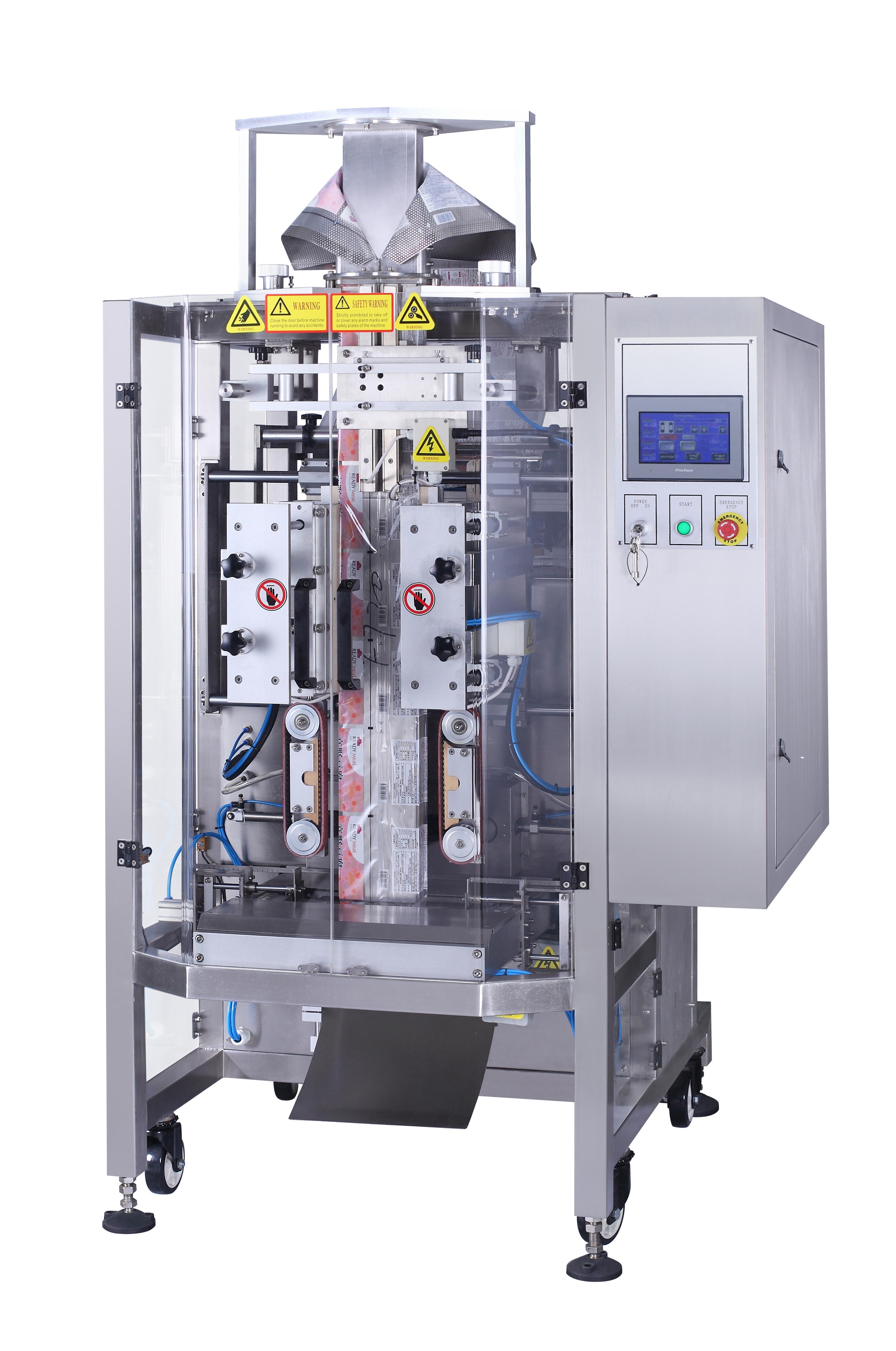
Mechanical and software integration must be flawless. You must time the product drop exactly with the closing of the sealing jaws. If the jaws close too early, they crush the product. If they close too late, you lose valuable cycle time. Perfect timing requires precise PLC programming and responsive servo motors driving the jaw carriage.
A high speed packaging machine often utilizes continuous motion technology. Intermittent motion stops the film for every seal, limiting throughput. Continuous motion keeps the film moving downward constantly while the jaws travel vertically with it. The dosing cycle must keep up with this rapid, non-stop movement. Sluggish fillers cannot pair with continuous motion baggers. The filler must discharge the product in a tight, fast cluster to fit between the moving jaws.
You must examine the physics of the product falling through the forming tube. Gravity acts uniformly, but air resistance changes everything inside the confined space of the tube. Dense products fall quickly in a tight cluster. Lightweight or aerodynamic products flutter and spread out during the drop. This spread elongates the product charge, increasing the risk of trailing product getting caught in the seal.
Longer settling times slow down your entire operation. Aerodynamic products may require staging gates inside the tube. These pneumatic gates catch the product halfway down, regroup it into a tight cluster, and drop it a shorter distance into the bag. Vacuum pull-down belts can also help control the film speed to match the settling time. You must engineer the drop dynamics to maintain throughput.
Gravity-fed systems demand significant vertical space. Multi-head weighers sit high above the bagger. The product must fall from the scale, through the transition funnel, and down the forming tube. You must measure your ceiling height before specifying equipment. Lack of vertical clearance remains a common integration failure that forces plants to cut holes in their roof or abandon the project.
You often need structural support above the bagger. Mezzanines provide a platform for the scale and safe access for operators to perform sanitation. Bucket elevators or incline conveyors must transport product up to the scale. You must plan the logistical footprint for all these components. The total system footprint is much larger than the bagger alone.
The dosed product dictates your film choice, which dictates your sealing technology. Multi-layer laminates require constant heat sealing. The jaws maintain a set temperature using cartridge heaters and thermocouples to melt the inner sealant layer. Unsupported films like polyethylene (PE) require impulse sealing. Impulse jaws heat up instantly via a ribbon wire and cool down while holding the seal closed.
Liquid or highly dusty products complicate sealing. Powders can coat the inner film layer, preventing the plastic from fusing. Liquids can splash up into the seal zone. You need specific barrier films to handle these conditions. You also need specialized jaw profiles. Serrated jaws push through minor contamination better than flat jaws by applying concentrated pressure at the peaks of the serrations. The right combination ensures hermetic seals.
Hygienic design is critical in food and pharmaceutical environments. You must evaluate the Ingress Protection (IP) ratings of every electrical enclosure and motor. IP65 protects against low-pressure water jets. IP69K withstands high-pressure, high-temperature washdowns. Both the dosing unit and the bagger must meet your facility's specific sanitation requirements.
Integrating two separate pieces of equipment complicates compliance. FDA, FSMA, or USDA regulations apply to the entire system. Catch pans, transition chutes, and mounting brackets must feature sanitary continuous welds. There can be no catch points, flat horizontal surfaces, or exposed threads where bacteria can harbor. The entire integrated system must pass rigorous hygiene inspections before production begins.
Independent control systems create communication bottlenecks. When the filler and bagger utilize different programmable logic controllers (PLCs), they must exchange hardwired "handshake" signals. The filler sends a signal saying "I am ready to drop." The bagger sends a signal saying "I am ready to receive." This back-and-forth introduces millisecond delays into the cycle.
These delays compound over thousands of cycles, causing you to lose significant throughput. Specify a single-source control system whenever possible. If you must use separate PLCs, require standardized industrial communication protocols. EtherNet/IP or PROFINET provide faster, more reliable data exchange than hardwired relay logic. Seamless communication eliminates handshake delays and allows a VFFS machine to run at its true mechanical limit.
Dust is a massive operational hazard in powder applications. Airborne particles coat optical sensors, causing false readings and machine faults. Dust settles in the seal zone, ruining seal integrity. Static electricity makes the problem exponentially worse. Static causes powders to cling to the inside of the forming tube and the inner web of the film, guaranteeing seal contamination.
You must implement active mitigation tactics. Enclose the dosing heads completely to contain airborne particles. Install dust extraction ports near the transition funnel to pull negative pressure on the dust. Mount static elimination bars on the film unwind carriage. These bars ionize the air and neutralize the static charge before the film forms into a tube around the collar.
You cannot blindly trust the initial dosing weight. The automatic dosing system requires continuous validation. Downstream checkweighers weigh every single sealed bag as it exits the machine. They reject out-of-tolerance bags automatically using pneumatic pushers. More importantly, they feed data back to the filler to adjust the target weight dynamically if the trend drifts.
Spatial integration of inspection equipment is crucial. Metal detectors or X-ray systems must fit seamlessly into the line. You can place throat metal detectors between the dosing system and the bagger to inspect the product in free-fall. Alternatively, you can inspect the finished bag immediately after sealing on the discharge conveyor. Software integration ensures any contaminated bag is tracked through shift registers and rejected reliably.
Never accept delivery without a rigorous Factory Acceptance Test (FAT). Testing the bagger and filler separately proves nothing. You must test them as a fully integrated system on the manufacturer's floor. Outline a strict FAT checklist before signing the purchase order to hold the vendor accountable.
Run the actual production material, not a substitute.
Use the exact film structure and roll width you will use in the plant.
Test the system at the contracted production speed for a continuous hour.
Verify changeover times by swapping forming tubes and dosing tooling.
Execute full sanitation teardown procedures to verify hygienic design.
Take the following immediate actions to specify your packaging line:
Document your product's exact bulk density, flow characteristics, and target weights before contacting vendors.
Measure your facility's vertical clearance and footprint constraints at the specific installation site.
Define your required bags per minute (BPM) and maximum acceptable material waste margins.
Request a physical product run test from shortlisted equipment manufacturers using your actual production film on a vertical form fill seal machine.
A: Volumetric systems measure product by physical space using cups or cavities. Gravimetric systems measure product by actual weight using load cells. Gravimetric equipment provides higher accuracy for products with varying bulk densities. Volumetric equipment offers faster cycle speeds and mechanical simplicity for highly uniform products.
A: While the base machine frame can sometimes be adapted, handling both requires completely different dosing heads, forming tubes, and sealing jaw profiles. Powders need augers and dust control. Liquids need pumps and positive shut-off nozzles. Frequent changeovers between the two are highly impractical.
A: Multi-head weighers calculate optimal weight combinations in fractions of a second across multiple buckets. Because it evaluates multiple options simultaneously, the bagger never has to wait for a single scale to settle and reach the exact weight. This continuous readiness maximizes cycle speed.
A: Product in the seal zone is usually caused by timing issues between the dosing system drop and the jaw closure. It can also be caused by static electricity making product cling to the film, or improper forming tube design that elongates the product drop time.
A: Calculate your current bags per minute against the new machine's output to find the daily production increase. Factor in the reduction of material giveaway achieved by the new dosing system. Combine the increased throughput and material yield to determine your operational return on investment.


